 Contact us


In hydraulic piping systems, turbines, circulation, heat transfer, etc., when used for a period of time, you will see that the oil will turn black, and may appear scale, varnish layer on the walls and pipes. of equipment. In this article, Unioil, we would like to share with customers the information about the causes of deposits, varnish in the engine, the oil system, how to fix it, and introduce you to the system cleaning oil industrial systems to help customers choose appropriate treatment methods.
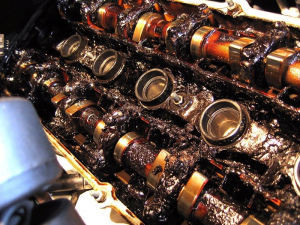
1. What causes deposits in industrial systems?
Deposits in the engine, heat transfer oil system are generated by the following factors:
– Working at high and continuous temperature, the system is not sealed, there is oxygen in the system => oxidized oil => residue
– Oil quality is poor, contains a lot of unsaturated compounds, high sulfur content => oil is easily degraded, oxidized, causing pipeline corrosion => bite structure, pipeline rust
– Using pipes, tank systems, heat transfer is not suitable, easy to corrode, rust
– The heat supply system (burning furnace) is not guaranteed, causing local overheating, or the oil is working at an excessive temperature => thermal cracking reaction => soot, residue, etc.
– For the engine: during incomplete combustion (lack of air, lack of oil, …) => produces soot, deposits on piston walls, pipelines, exhaust pipes
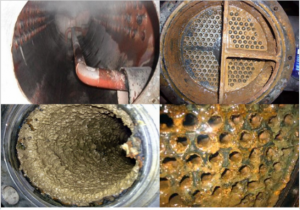
2. Harm of scale in industrial systems
- The biggest harm of scale is overheating which can lead to the fire tube cracking. The thermal conductivity of the porous layer is only similar to that of the insulating brick. The scale therefore acts as an insulating layer and prevents effective heat transfer through the fire tubes to the boiling water contained in the furnace.
- The decrease in thermal conductivity also means low efficiency of the furnace, causing overheating and can cause the fire tubes to soften, swell and crack because the flame tube material must work at high temperatures. a temperature above the allowable threshold.
Corrosion phenomenon under the sediment layer causes the following harmful effects:
- Increased fuel consumption due to poor heat transfer efficiency.
- Heat loss, reduce boiler efficiency
- Pipe breakage due to overheating.
- Increased downtime due to repair
- Increased repair and maintenance costs
- Danger to human life due to boiler explosion: When too much scale accumulates, it will seal the steam pipeline to the working sites. When the pipeline is sealed, the steam cannot escape and the pressure in the boiler increases, causing the steam pipeline to explode.
3. Industrial system cleaning oil
Why use washing oil?
- When changing the oil, the system must be cleaned to ensure the best performance, because the varnish deposits in the system will quickly reduce the quality of the system, causing poor efficiency and equipment damage.
- Need to use washing oil to clean before changing new oil
- Washing oil has the ability to clean and dissolve dirt, clinging to equipment and pipes.
- Has low viscosity, high fluidity
- For some cleaning oils, an additive is added to help clean the pipeline, neutralize acidic deposits in the system (this residue is generated by oxidation, heat metabolism) , prevent corrosion, rust in pipes, systems
Requirements of a washing oil?
- Capable of dissolving most of the oil deposits in the system
- Has the right viscosity, easy to circulate in pipes, systems
- Does not cause corrosion
- Able to neutralize acidic components in the system
- Has volatility, boiling range suitable for high temperature heat transfer pipe cleaning applications
EPILOGUE
Through the article Unioil has compiled basic information about the causes of scale and varnish formation in the equipment after a period of use and effective treatment methods, so that customers can have information and choose products. suitable for maximum efficiency. If you have any questions, you can comment at the bottom of the article or call us directly for answers.
UNILUBRICATION – PREMIUM LUBRICANTS
Hotline: 0938 809 226
Email: info@unilubrication.com
Website: www.uniolubrication.com
Facebook: https://www.facebook.com/Unilubrication